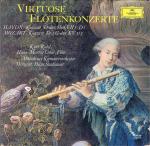
Joseph Haydn, Mozart, Kurt Redel, Hans-Martin Linde & Münchener Kammerorchester - Virtuose Flötenkonzerte (Haydn: Konzert D-dur, Hob. VIIf: D1 ) - Deutsche Grammophon - Classical
<< Back
Some Other Artists in the Classical Genre
• James Last • John Williams • Ludwig van Beethoven • Jean Sibelius, Sir John Barbirolli & Hallé Orchestra • The London Symphony Orchestra & The Royal Choral Society • Wolfgang Amadeus Mozart • Frédéric Chopin & Samson François • Sir Edward Elgar, Sir Adrian Boult & London Philharmonic Orchestra • Unknown Artist • Ivor Novello • Antonín Dvo?ák, István Kertész & London Symphony Orchestra • Ludwig van Beethoven, Otto Klemperer & Philharmonia Orchestra • Jean Sibelius, Lorin Maazel & Wiener Philharmoniker • Mantovani And His Orchestra • Vangelis • Franz Schubert, Karl Böhm & Berliner Philharmoniker • Frank Bridge & Ernest John Moeran • Coro E Orchestra Del Teatro Alla Scala & Umberto Berrettoni • John Keating • Tomita & Claude Debussy • Aled Jones • Sky • Tomita • The London Philharmonic Orchestra • Hector Berlioz, Herbert von Karajan & Berliner Philharmoniker • Gustav Mahler & Bruno Walter & The New York Philharmonic Orchestra • Mark Burton • Gioacchino Rossini & Friedrich Wilhelm Rust & Robert-Nicholas-Charles Bochsa & Carl Philipp Emanuel Bach & Heinz Holliger & Ursu • Thijs Van Leer • Klaus Wunderlich • Guido Cantelli • Igor Stravinsky & The Philadelphia Orchestra & Riccardo Muti • Wolfgang Amadeus Mozart & Josef Suk & Prague Chamber Orchestra • Walter Gieseking & Felix Mendelssohn-Bartholdy • Manuel And His Music Of The Mountains • Ludwig van Beethoven, André Cluytens & Berliner Philharmoniker • Sir Edward Elgar, Paul Tortelier, Sir Adrian Boult & London Philharmonic Orchestra • The Sinfonia Of London & The Ambrosian Singers • Richard Hartley & Michael Reed Orchestra • Solomon (6) & Ludwig van Beethoven •
More from Classical >>
|
Some Other Artists on the Deutsche Grammophon Label
• Wolfgang Amadeus Mozart & Philharmonische Solisten Berlin • Hector Berlioz, Herbert von Karajan & Berliner Philharmoniker • Franz Schubert, Karl Böhm & Berliner Philharmoniker • Pyotr Ilyich Tchaikovsky, Herbert von Karajan & Berliner Philharmoniker • Ludwig van Beethoven & Wilhelm Kempff • Johann Sebastian Bach & Nathan Milstein • Pyotr Ilyich Tchaikovsky & Berliner Philharmoniker & Herbert von Karajan • César Franck & Radio-Symphonie-Orchester Berlin & Lorin Maazel • Johann Sebastian Bach, Irmgard Seefried, Hertha Töpper, Ernst Haefliger, Kieth Engen, Dietrich Fischer-Dieskau & Karl Richt • Wolfgang Amadeus Mozart, Randall Wolfgang, Frank Morelli, William Purvis & Orpheus Chamber Orchestra • Wolfgang Amadeus Mozart, Herbert von Karajan & Berliner Philharmoniker • Max Bruch & Johann Sebastian Bach & David Oistrach & Igor Oistrach • Johann Sebastian Bach & David Oistrach & Igor Oistrach • Wolfgang Amadeus Mozart • Pyotr Ilyich Tchaikovsky & Berliner Philharmoniker & Ferdinand Leitner • Wolfgang Amadeus Mozart & The London Symphony Orchestra & Rudolf Serkin & Claudio Abbado • Frédéric Chopin & Krystian Zimerman • Leonard Bernstein • Felix Mendelssohn-Bartholdy & Max Bruch & Anne-Sophie Mutter & Berliner Philharmoniker & Herbert von Karajan • Hector Berlioz & Kiri Te Kanawa & Jessye Norman & Orchestre De Paris & Daniel Barenboim • Ludwig van Beethoven & Joseph Haydn & Trio Di Trieste • Robert Schumann & Pyotr Ilyich Tchaikovsky & Mstislav Rostropovich & Leningrad Philharmonic Orchestra & Gennadi Rozhdestvensky • Ludwig van Beethoven & Amadeus-Quartett • Ravi Shankar • Wolfgang Amadeus Mozart, Anne-Sophie Mutter, Herbert von Karajan & Berliner Philharmoniker • Antonio Vivaldi & Michel Schwalbé & Berliner Philharmoniker & Herbert von Karajan • Johannes Brahms & Herbert von Karajan & Berliner Philharmoniker • Max Bruch & Johann Sebastian Bach & David Oistrach & Igor Oistrach & Royal Philharmonic Orchestra • Ludwig van Beethoven • Wolfgang Amadeus Mozart & Krystian Zimerman • Ludwig van Beethoven, Eugen Jochum & Symphonie-Orchester Des Bayerischen Rundfunks • Leoš Janá?ek, Rudolf Firkušný, Mitglieder Des Symphonie-Orchesters Des Bayerischen Rundfunks & Rafael Kubelik • Wolfgang Amadeus Mozart & Géza Anda & Camerata Academica Salzburg • Johannes Brahms, Nathan Milstein, Eugen Jochum & Wiener Philharmoniker • Tamás Vásáry & Berliner Philharmoniker • Maurice Ravel, Daniel Barenboim & Orchestre De Paris • Berliner Philharmoniker & Don Kosaken Chor Serge Jarof • Sir Edward Elgar, Leonard Bernstein & BBC Symphony Orchestra • Heitor Villa-Lobos & Roberto Szidon • Gustav Mahler, Rafael Kubelik & Dietrich Fischer-Dieskau & Symphonie-Orchester Des Bayerischen Rundfunks •
More from Deutsche Grammophon >>
|
Information on the Classical Genre
Classical music, strictly defined, means music produced in the western world between 1750 and 1820. This music included opera, chamber music, choral pieces, and music requiring a full orchestra. To most, however, classical music refers to all of the above types of music within most time periods before the 20th century.
Classical music in its limited definition includes the works of Haydn, Mozart and Beethoven. From Mozart, a huge range of pieces offer us a chance to enjoy. Mozart wrote symphonies, music for quartets and quintets, chamber orchestra pieces, choral pieces, piano concertos, and entire operas. In total, he wrote over 600 musical pieces. He is perhaps best known for his opera, The Magic Flute . Most also recognize Eine Kleine Nachtmusik, as well as a number of his symphonies and concertos.
Classical music would not be quite the same without Beethoven, who is particularly known for his symphonies. Beethoven’s sixth symphony is probably most recognized because of its pastorale, a section of music used in the Disney film Fantasia. The achingly beautiful Moonlight Sonata is also Beethoven. Beethoven wrote only one opera, Fidelio. His genius rests in his symphonies and piano concertos, and some Beethoven must be in the catalog of anyone who loves classical music.
Haydn has often been referred to as the “father of classical music.†His work during this era forms the basis of influence for others who wrote classical music. Ironically, though he is considered the progenitor of classical music, he is less familiar to most audiences than the composers mentioned above. His Symphony no. 94, The Surprise Symphony, is among his best known works.
Classical music in the broader definition evokes such composers as Bach, who preceded the more rigidly defined classical music era and is more rightly classed in the Baroque period. Vivaldi, perhaps best remembered for The Four Seasons is also of the Baroque period. Handel’s Messiah is well known to the many who participate in sing-alongs during the Christmas season.
The Romantic Period, which follows directly after the classical period, is known for its emotive qualities. Mahler and Sibelius stand out and tend to be familiar to most. Wagner is perhaps the most frequently recognized of the Romantic composers, his work stormy and grand, and his many operas still performed regularly today.
Classical music may also refer to the native and folk music of any country. The styles vary greatly depending upon available instruments. For example, the classical music of Indonesia, with its use of the gamelan, is vastly different from what most would consider classical music of the western world. Folk traditions in other countries may seem more influential to western classical music. Musicians of the baroque and classical periods often adapted their works from folk music.