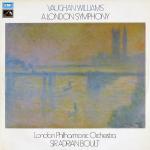
Ralph Vaughan Williams, Sir Adrian Boult & London Philharmonic Orchestra - A London Symphony - His Master's Voice - Classical
<< Back
Some Other Artists in the Classical Genre
• James Last • John Williams • The London Symphony Orchestra & The Royal Choral Society • Dmitri Shostakovich, Maxim Shostakovich & Russian State Symphony Orchestra • Jean Sibelius, Sir John Barbirolli & Hallé Orchestra • Jean Sibelius, Lorin Maazel & Wiener Philharmoniker • Ludwig van Beethoven • Ivor Novello • Ludwig van Beethoven & Wilhelm Kempff • Unknown Artist • Ludwig van Beethoven, Otto Klemperer & Philharmonia Orchestra • Vangelis • Mantovani And His Orchestra • Wolfgang Amadeus Mozart • Maria Callas • Frédéric Chopin & Samson François • Franz Schubert & Alfred Brendel • Thijs Van Leer • Sir Edward Elgar, Sir Adrian Boult & London Philharmonic Orchestra • Pyotr Ilyich Tchaikovsky, Kenneth Alwyn & London Symphony Orchestra • Coro E Orchestra Del Teatro Alla Scala & Umberto Berrettoni • Ludwig van Beethoven, Herbert Von Karajan & Berliner Philharmoniker • The London Philharmonic Orchestra • Sky • Ludwig van Beethoven, André Cluytens & Berliner Philharmoniker • Aled Jones • Gustav Mahler & Bruno Walter & The New York Philharmonic Orchestra • Frank Bridge & Ernest John Moeran • The Sinfonia Of London & The Ambrosian Singers • Richard Hartley & Michael Reed Orchestra • Stephen Hicks • Gioacchino Rossini & Friedrich Wilhelm Rust & Robert-Nicholas-Charles Bochsa & Carl Philipp Emanuel Bach & Heinz Holliger & Ursu • Tomita & Claude Debussy • Sir Edward Elgar, Leonard Bernstein & BBC Symphony Orchestra • Sir Edward Elgar, Paul Tortelier, Sir Adrian Boult & London Philharmonic Orchestra • Igor Stravinsky & The Philadelphia Orchestra & Riccardo Muti • Wolfgang Amadeus Mozart & Josef Suk & Prague Chamber Orchestra • Mark Burton • Guido Cantelli • Sir William Walton & André Previn •
More from Classical >>
|
Some Other Artists on the His Master's Voice Label
• Andrew Lloyd Webber • Orchestra Of The Royal Opera House, Covent Garden & John Lanchbery • Jean Sibelius, Sir John Barbirolli & Hallé Orchestra • Richard Wagner, Otto Klemperer & Philharmonia Orchestra • Pyotr Ilyich Tchaikovsky, Guido Cantelli & Philharmonia Orchestra • Gyorgy Cziffra • Jean Sibelius, Sir Malcolm Sargent & Wiener Philharmoniker • Ralph Vaughan Williams, Sir Adrian Boult & London Philharmonic Orchestra • Sergei Rachmaninoff, André Previn & London Symphony Orchestra • Sir William Walton & André Previn • Fats Waller & His Rhythm • Ludwig van Beethoven, Yehudi Menuhin, Wilhelm Furtwängler & Philharmonia Orchestra • Eydie Gormé • Sir Edward Elgar, Jacqueline Du Pré, Sir John Barbirolli & London Symphony • Joe Loss & His Orchestra • Pyotr Ilyich Tchaikovsky, Guido Cantelli & Orchestra Del Teatro Alla Scala • Pyotr Ilyich Tchaikovsky, Riccardo Muti & Philadelphia Orchestra • Ray Charles And His Orchestra • Scott Joplin • The Early Music Consort Of London & David Munrow • Mel Tormé & Marty Paich Orchestra • Louis Frémaux & City Of Birmingham Symphony Orchestra • Winston Churchill • Manfred Mann • Meade Lux Lewis • Georg Philipp Telemann, Hans-Martin Linde, Lucy van Dael, Jordi Savall & Alan Curtis • Melina Mercouri & Don Costa Orchestra • Camille Saint-Saëns, Michel Béroff, Jean-Philippe Collard & Maurice André • Johnny Kidd & The Pirates • Sauter-Finegan Orchestra • Orchestra Of The Royal Opera House & John Lanchbery • Sergei Prokofiev, Enrique Batiz & London Philharmonic Orchestra • Sergei Prokofiev, Camille Saint-Saëns, Efrem Kurtz & Philharmonia Orchestra • Glenn Miller And His Orchestra • John Ogdon & Philharmonia Orchestra • Nikolai Rimsky-Korsakov, Paul Kletzki & Philharmonia Orchestra • Mily Balakirev, Anatoly Liadov, Neeme Järvi & City Of Birmingham Symphony Orchestra • Georges Bizet & Risë Stevens & Jan Peerce & Licia Albanese & Robert Merrill & Fritz Reiner • Vera Gray & Desmond Briscoe • Sarah Brightman, Paul Miles-Kingston & Placido Domingo •
More from His Master's Voice >>
|
Information on the Classical Genre
Classical music, strictly defined, means music produced in the western world between 1750 and 1820. This music included opera, chamber music, choral pieces, and music requiring a full orchestra. To most, however, classical music refers to all of the above types of music within most time periods before the 20th century.
Classical music in its limited definition includes the works of Haydn, Mozart and Beethoven. From Mozart, a huge range of pieces offer us a chance to enjoy. Mozart wrote symphonies, music for quartets and quintets, chamber orchestra pieces, choral pieces, piano concertos, and entire operas. In total, he wrote over 600 musical pieces. He is perhaps best known for his opera, The Magic Flute . Most also recognize Eine Kleine Nachtmusik, as well as a number of his symphonies and concertos.
Classical music would not be quite the same without Beethoven, who is particularly known for his symphonies. Beethoven’s sixth symphony is probably most recognized because of its pastorale, a section of music used in the Disney film Fantasia. The achingly beautiful Moonlight Sonata is also Beethoven. Beethoven wrote only one opera, Fidelio. His genius rests in his symphonies and piano concertos, and some Beethoven must be in the catalog of anyone who loves classical music.
Haydn has often been referred to as the “father of classical music.†His work during this era forms the basis of influence for others who wrote classical music. Ironically, though he is considered the progenitor of classical music, he is less familiar to most audiences than the composers mentioned above. His Symphony no. 94, The Surprise Symphony, is among his best known works.
Classical music in the broader definition evokes such composers as Bach, who preceded the more rigidly defined classical music era and is more rightly classed in the Baroque period. Vivaldi, perhaps best remembered for The Four Seasons is also of the Baroque period. Handel’s Messiah is well known to the many who participate in sing-alongs during the Christmas season.
The Romantic Period, which follows directly after the classical period, is known for its emotive qualities. Mahler and Sibelius stand out and tend to be familiar to most. Wagner is perhaps the most frequently recognized of the Romantic composers, his work stormy and grand, and his many operas still performed regularly today.
Classical music may also refer to the native and folk music of any country. The styles vary greatly depending upon available instruments. For example, the classical music of Indonesia, with its use of the gamelan, is vastly different from what most would consider classical music of the western world. Folk traditions in other countries may seem more influential to western classical music. Musicians of the baroque and classical periods often adapted their works from folk music.